
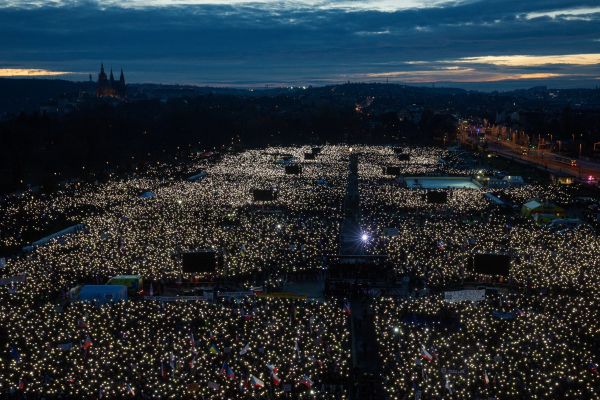
On Sunday, a major rally took place in Prague, drawing hundreds of thousands of participants who opposed a proposed plan by the far-right government led by Czech billionaire Andrej Babiš to overhaul the funding structure for public broadcasters. Critics argue that it poses a serious threat to media independence and democratic values.
The European Commission, along with political groups in the European Parliament, expressed concern during a European Parliament Plenary Debate on Media freedom and the rule of law in the Czech Republic, citing threats to the independence of public broadcasters.
The protest was held at Letná Park, a historic location synonymous with the 1989 Velvet Revolution, which marked the end of over four decades of communist rule in Czechoslovakia. The event coincided with the upcoming anniversary of those pivotal demonstrations. It drew an estimated 350,000 people, said Mikuláš Minář, the lead organiser from the Million Moments for Democracy movement.
Attendees called for the government to retract its proposal, voicing concerns about the implications of Babiš and his coalition partners for the country’s democratic future. “What we witness here today is exceptional,” Minář stated. “This is merely the beginning.”
Far-right government wants control of media
The proposed changes would shift funding for public radio and television broadcasters to the state budget, replacing the current system, which relies on regular fees contributed by individuals, households, and businesses. This modification could reduce funding by approximately 15%, potentially leading to job cuts, reduced production capacity, and the cancellation of programming.
Critics argue that such changes may empower the three-party coalition to control the media, drawing parallels to actions taken by authoritarian governments in Slovakia under Prime Minister Robert Fico and in Hungary before the ousting of former Prime Minister Viktor Orbán in April.
Protesters displayed banners bearing messages such as “We refuse the Slovak scenario” and “Hands off the media.” Among the demonstrators, singer Šarka Dumišincová articulated her perspective, stating, “The media represent freedom. The attempt to control that freedom is unacceptable, which is why I am here today.”
The government apparently wants to rush the bill through Parliament
On 24 October, the ruling coalition took the unexpected step of advancing their plan in the lower house of Parliament. They imposed restrictions on the opposition’s speaking time before a vote at 4:36 a.m., allowing the bill to progress through the first of three parliamentary readings.
In response to this expedited process, thousands of citizens gathered in protest the following day. Additionally, public media employees initiated a strike on 3 November, which received widespread support from labour unions, universities, students, religious organisations, artists, athletes, and various international media organisations.
During a speech on Sunday, Minář emphasised, “We are here to stand up against the rule by force in the style of 4:36,” referring to the time at which the bill cleared its first reading.
Babiš has opposed other EU policies
Babiš has committed to advancing his agenda despite ongoing protests, asserting that these actions will not compromise media freedom. He returned to power in the Czech Republic after his ANO movement won the recent elections and formed a coalition with two smaller political parties: the right-wing extremist, pro-Russian Freedom and Direct Democracy (SPD) party, and the far-right Motorists for Themselves party. ANO and the Motorists are members of the far-right Patriots for Europe (PfE), while SPD is a member of the AfD-led Europe of Sovereign Nations (ESN).
Babiš has expressed opposition to several key European Union policies related to environmental and migration issues, and he has declined financial support for Ukraine, along with guarantees for EU loans intended to assist in its resistance against the Russian invasion. His government has faced scrutiny from NATO allies for insufficient defence spending.
Additionally, protesters have voiced concerns regarding the government’s defence policy and have called for the resignations of Tomio Okamura, the leader of the Freedom Party and the parliamentary Speaker, as well as Defence Minister Jaromír Zůna, given the party’s oversight of the ministry.
On 11 November, Okamura released a statement on social media following a coalition council meeting. He confirmed that the government coalition has agreed not to allow Czech soldiers to participate in military exercises supporting Ukraine or engage in military operations within the country.
Minář, the primary organiser of the protests, stated, “The pro-Russian party is systematically undermining the state’s defensive capability and endangering national security while President Putin poses a threat to Europe.”
European Commission and Parliament concerned about media freedom deterioration
Addressing the European Parliament Plenary Debate on Media freedom and rule of law in the Czech Republic: threats to the independence of public broadcasters on 11 November, Michael McGrath, EU Commissioner for Democracy, Justice, the Rule of Law and Consumer Protection, highlighted that media freedom and pluralism are vital for the rule of law and democracy. He said that since 2020, the Commission has focused on safeguarding these principles through various EU initiatives, including the European Media Freedom Act (EMFA). These initiatives ensure citizens can access reliable information and engage in public life.
“The Commission has closely engaged with all Member States, including Czechia, to ensure that the EMFA safeguards, including those on public service media, are in place as soon as possible in each national legal framework,” he said.
“I would also like to stress that any legislative proposal should proceed through a duly conducted legislative process, ensuring full respect for the applicable institutional framework and allowing for meaningful consultation of relevant stakeholders before adoption,” he added.
He noted that the 2026 Rule of Law Report has recommended that the Czech Republic take measures to improve transparency in the legislative process and meaningful consultation of stakeholders, including by addressing the frequent use of fast-track procedures.
He also said the 2026 Rule of Law Report notes that in the Czech Republic, journalists continue to face serious verbal threats and harassment.
The EPP Group raised concerns during the debate about the Czech government’s plan to replace license fees for public service media with state budget funding. They warned this change could threaten the independence of Czech Television and Czech Radio, allowing for political interference in their editorial decisions.
Speaking ahead of a European Parliament debate on Wednesday, Lena Düpont MEP, the EPP Group’s Spokeswoman for Home Affairs, stated: “Any reform must fully respect the European Media Freedom Act and guarantee adequate and predictable funding to safeguard editorial independence and media pluralism. Reforming public service media financing must strengthen their independence, not make them more vulnerable to political influence.”
Veronika Vrecionová, MEP for the ECR Group, warned that the proposed changes are not about saving public money, but about bringing Czech Television and Czech Radio under government control.
“The government claims it has no intention of interfering with editorial content. But we should judge it by its actions, not its promises. When Andrej Babiš entered politics and acquired two of the country’s most influential newspapers, criticism of him virtually disappeared from their pages. We have every reason to be concerned about what could happen to public service media,” she said.
This article used information from The Associated Press.
