
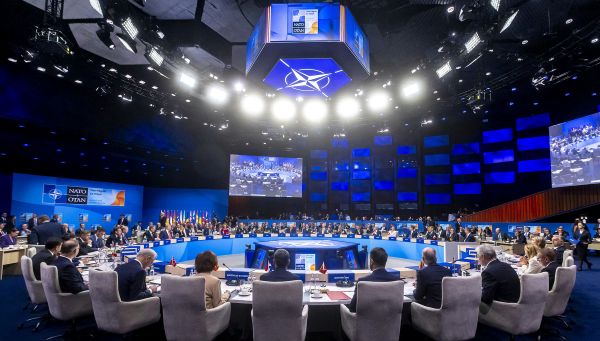
NATO leaders meeting in the Netherlands have agreed to raise defence spending to a 5% GDP level while pledging an “ironclad commitment” to help defend one another in the event of an attack on any individual member.
Accordingly, the agreement states: “Allies commit to investing 5% of GDP annually on core defence requirements as well as defence- and security-related spending by 2035 to ensure our individual and collective obligations.”
The summit’s concluding statement reflects acceptance of U.S. President Donald Trump‘s demands that NATO members substantially step up defence spending in meeting their alliance obligations.
Describing the jump in spending, which requires members to spend billions more on defence, as something no one had “really thought possible”, Trump noted that now he was being credited for the breakthrough, adding: “Well, I don’t know if I did it, but I think I did.”
The investment pledge requires members to spend billions of dollars more on defence. It does, however, provide for a review in 2029), which will give NATO members the opportunity to monitor progress and to reassess the Russian security threat.
Spain riled Trump by have already stated its inability to meet the new spending target, terming it and the 2035 deadline “unreasonable”. Belgium has also flagged that it would not meet the targets. Slovakia insisted it alone has the right to decide its own defence spending. Other members have cited reservations as well.
The NATO leaders reiterated their “ironclad commitment” to the Alliance’s collective security guarantee – “that an attack on one is an attack on all.”
NATO Secretary-General Mark Rutte told reporters after the summit that the leaders’ deliberations had opened the way “for a stronger, fairer and more lethal NATO”, one that would “fuel a quantum leap in our collective defence.”
Spain’s Prime Minister Pedro Sánchez declared afterwards that Madrid was limited to spending only 2% of GDP to execute NATO’s defence plans, citing the need to balance security with the demands of the welfare state.
Trump took issue with Spain’s approach. “They want to stay at 2%. I think it’s terrible,” he said. “You know, what we’re going to do? We’re negotiating with Spain on a trade deal. We’re going to make them pay twice as much.”
Several other European countries facing similar economic challenges are wary of Trump’s global tariff war, fearing it could make it even harder for them to meet their targets.
Countries situated closer to Russia and Ukraine — including Poland, the Baltic states, and Nordic countries — have committed to the 5% goal, as have Britain, France, Germany, and the Netherlands.
“We stand by Ukraine in its pursuit of peace and will continue to support Ukraine on its irreversible path to NATO membership,” Rutte stressed. The Trump administration is currently determined to veto Ukraine’s membership bid.
Asked why the new spending target should not apply to the United States, Rutte said, “The U.S. is more or less there” in terms of meeting the 5% benchmark.
Finland’s President Alexander Stubb described the NATO agreement as “a big win” for both Trump and Europe but conceded that a new, “more balanced NATO” would mean reverting to Cold War expenditure levels.
U.K. Prime Minister Keir Starmer hailed the summit outcome as a “moment to unite, for Europe to make a fundamental shift in its posture and for NATO to meet this challenge head-on.” A possibly MAGA-inspired Lithuanian President, Gitanas Nausėda, suggested a new motto – “make NATO Great Again.”
Following Russia’s 2022 invasion of Ukraine, NATO allies agreed to make 2% of GDP the minimum spending level, a target 22 members were expected to achieve last year compared to just three a decade ago.
The Hague summit raised the ante for what NATO calls “core defence spending” to 3.5% but changed how this should be assessed to include provision of military support to Ukraine. To ensure that Trump’s 5% GDP demand is realised, the summit set a second target of 1.5% of GDP for a broader range of defence-related spending on items such as road, bridge, port and airfield improvements to enable armies to deploy more quickly, measures to counter cyber and hybrid attacks, and preparing societies to deal with future conflicts.
Norway’s Prime Minister Jonas Gahr Støre stressed how 32 allies had been “struggling to get above 2%, and now we said 3.5%, which is necessary in order to reach our capabilities.”
Should the Trump administration, as expected, announce a draw-down of the 84,000-strong U.S. force in Europe, additional funds will be required so that European allies can plug any ensuing security gaps.
