
Romania faces the risk of a credit rating downgrade to “junk” status, meaning it would be deemed unsuitable for investment. This concern stems from a protracted political crisis that threatens the country’s fiscal integrity, Bloomberg reports, citing a Fitch Ratings analyst.
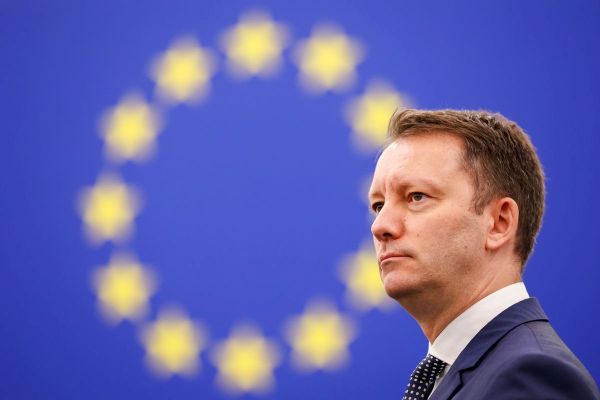
This caution follows President Nicușor Dan‘s nomination of Siegfried Mureșan as prime minister. In light of this, leaders from both the Social Democratic Party (PSD) and the right-wing extremist Alliance for the Union of Romanians (AUR) have said they will not support Mureșan’s candidacy.
PSD and extremists team up against reforms
Romania’s pro-European coalition faces a major challenge after a recent vote removed Prime Minister Ilie Bolojan from office, less than a year after his inauguration. This no-confidence vote introduced a new layer of political uncertainty within the European Union. It posed a considerable setback for Bolojan, who had been working to navigate one of the most serious political crises in Romania’s post-communist history.
The Social Democrats (PSD) and the right-extremist opposition Alliance for the Unity of Romanians (AUR) jointly submitted the motion for no confidence to Parliament on 28 April. This action followed the PSD’s withdrawal from the coalition government the previous month, thereby intensifying the ongoing political crisis.
After assuming office in June 2025, the coalition government’s primary focus was to reduce the budget deficit. Throughout this period, the PSD has engaged in ongoing disputes with Bolojan regarding a range of austerity measures, including tax increases, freezes on public-sector wages and pensions, and reductions in state spending and public administration roles. Despite these obstacles, the Bolojan administration introduced significant fiscal reforms.
On 14 May, the European Commission issued a favourable preliminary assessment of Romania’s fourth payment request for €2.62 billion under the Recovery and Resilience Facility (RRF), a key element of the NextGenerationEU initiative. Recognising the Bolojan administration’s outcomes, the Commission noted that Romania had satisfactorily fulfilled the requirements of 38 milestones and 24 targets outlined in the Council Implementing Decision. This accomplishment largely reflects the previous government led by Ilie Bolojan, which implemented substantial fiscal reforms to align Romania’s economic framework with its obligations as a member of the European Union.
Romania still needs to reduce budget deficit
The government’s ability to reduce the budget deficit and present a credible fiscal plan is crucial for assessing its creditworthiness, as Fitch will review Romania’s rating in January 2027. Romania needs an additional deficit adjustment of about 1.5 percentage points of GDP to stabilise public debt growth. Drafting the 2027 budget and outlining a plan to meet the 3% deficit target are essential to avoid a downgrade.
Romania narrowly avoided a downgrade two months ago, but efforts to appoint a new prime minister with a stable majority have failed, raising the prospect of early elections. Fitch maintained Romania’s rating at BBB-—the lowest investment-grade rating—with a negative outlook in July after the government challenged the initial assessment.
On 2 October, S&P will announce its rating review results. However, the PSD and AUR parties seem more focused on their political agendas rather than the country’s interests. The ongoing political crisis, which began when the PSD and AUR dismissed the Bolojan government in May, continues to raise concerns, particularly as Romania strives to avoid recession and combat the EU’s highest inflation rate.
New government’s difficult mission
On 17 September, Romanian President Nicușor Dan nominated Siegfried Mureșan, a member of the European Parliament and a representative of the centre-right National Liberal Party (PNL), as prime minister. This decision aims to resolve the month-long political crisis that emerged after two previous nominees failed to secure a majority.
President Dan underscored that Mureșan was selected because he received broad support from various political parties during recent consultations, despite lacking a clear majority. The President highlighted Mureșan’s extensive experience in the European Parliament, where he has served since 2014 and currently serves as vice chair of the European People’s Party group.
“Romania needs a credible government as soon as possible. This is why I have accepted the Romanian President’s proposal to form a government. Our citizens need predictability. All our partners must be able to rely on a credible and responsible Romania,” Mureșan posted on X after he accepted the President’s proposal.
Mureșan is tasked with presenting a cabinet to Parliament within the next ten days. Sorin Grindeanu, the leader of the PSD, expressed both surprise and disappointment regarding this nomination and has indicated a commitment to continuing in the opposition. As he prepares to approach the Victoria Palace for his inauguration, he faces the challenge of lacking the required majority, needing about 50 additional votes despite backing from the PNL, USR, UDMR, and minorities MPs.
