
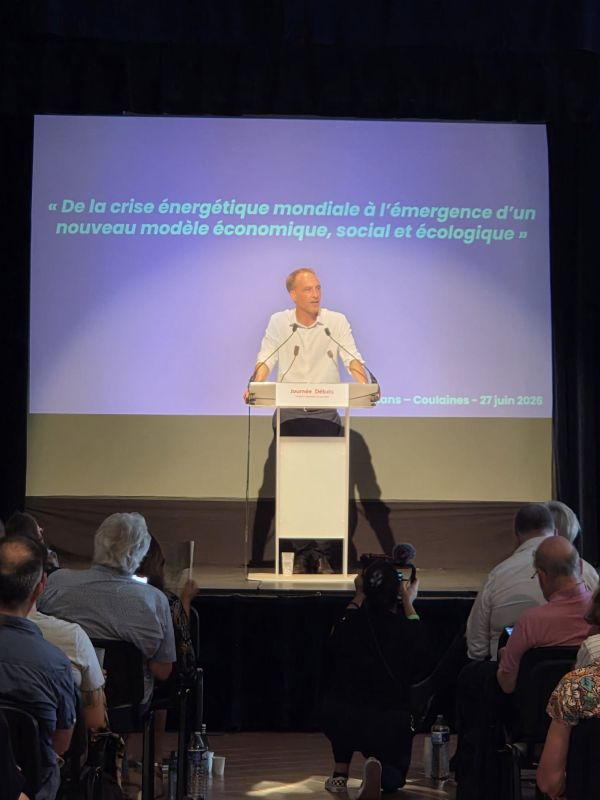
French center-left politician and Member of the European Parliament (MEP) Raphaël Glucksmann has officially declared his candidacy for the presidency, intending to challenge radical leftist leader Jean-Luc Mélenchon for leadership within France’s diverse Left. This announcement arrives amid an election campaign that is increasingly influenced by the far right. Glucksmann’s primary focus is on far-right leader Marine Le Pen, who currently holds a consistent lead in first-round voting intentions.
A broad coalition of political groups recognises that France ought not to be governed by far-right ideologies. Consequently, Glucksmann’s anticipated candidacy aims to position him as a contender capable of defeating Le Pen in the second round.
In an interview with the French television station TF1, Glucksmann affirmed his candidacy, stating, “Yes, I am a candidate in the presidential election. Are we going to hand over our country to the far right? Faced with such a choice, I could not remain uninvolved.”
Glucksmann’s fight against the far-right is not new
Raphaël Glucksmann has consistently raised concerns about the risks France may face if the far right, particularly Marine Le Pen, assumes power. In an op-ed published in the French daily Le Monde on 18 June 2024, he explained his apprehensions about the possibility of Le Pen’s National Rally securing an absolute majority in the National Assembly. He indicated that such an outcome would imply that “the main military power on the continent will be run by small telegraph operators from the Kremlin.”
Glucksmann elaborated on the potential ramifications of a National Rally-led government, which could result in the systematic dismantling of the European project, challenges to the rule of law, the privatisation of public broadcasting services, and the erosion of state medical aid. He emphasised that the far right poses a considerable threat to the integrity of the French political and social landscape.
In his remarks from 2024, Glucksmann emphasised, “All that matters now is the absolute necessity of closing the gates of Hell that a totally irresponsible President opened on 9 June.”
Uniting the Left
After French President Emmanuel Macron called for urgent legislative elections in 2024, the Left began strategising to prevent the rise of the far-right and to present itself as a viable governing force once again. Raphaël Glucksmann’s appeal for a Left coalition signifies a notable shift in the political landscape, positioning the Left as a key player in French politics.
Glucksmann, a pro-European, led the moderate-left alliance in the 2024 European Parliament elections, garnered 14% of the vote but is currently trailing Jean-Luc Mélenchon in opinion polls. The rise of the Réveiller l’Europe (Wake Up Europe) party, led by Socialist Party MEP Glucksmann, resulted in a doubling of its seats from 6 to 13, making it one of the election’s winners. A crucial question remains: can he unite the moderate left forces?
“The Left can win the presidential election if it stands firm on its principles,“ Glucksmann stated. “We have to stop being afraid of Mélenchon.“
Glucksmann’s candidacy emerges amid a highly polarised presidential campaign, especially with elections approaching in April and May 2027. While he criticises some of President Macron’s pro-business policies, Glucksmann also advocates a pro-European and pro-Ukrainian stance. He frequently emphasises the security risks posed by foreign interference and investments to the European Union.
“What are we waiting for to massively co-produce with the Ukrainians the missiles and defence systems that will protect us tomorrow? What are we waiting for to defend Ukraine with greater vigour and, in doing so, all of Europe?” Glucksmann posted on X on 2 July.
On 19 May, the European Parliament ratified new regulations with broad support, receiving 508 votes in favour, to screen foreign investments and mitigate security risks. MEPs reached an agreement with EU member states on mandatory screening of foreign investments in critical sectors, including defence, semiconductors, artificial intelligence, critical raw materials, and financial services. This aims to identify and address potential security and public order risks while ensuring an open environment for foreign capital inflows.
The Parliament’s rapporteur, Raphaël Glucksmann, emphasised that “With this text, we are closing a chapter of European naivety. Certain foreign states are seeking to weaken us. We are turning the page on the wilful blindness of Member States that allowed foreign actors to seize control of sensitive sectors of our economy. But our work on foreign investment is not finished – the fight for Europe’s independence and sovereignty continues, now with the proposed Industrial Accelerator Act.”
