
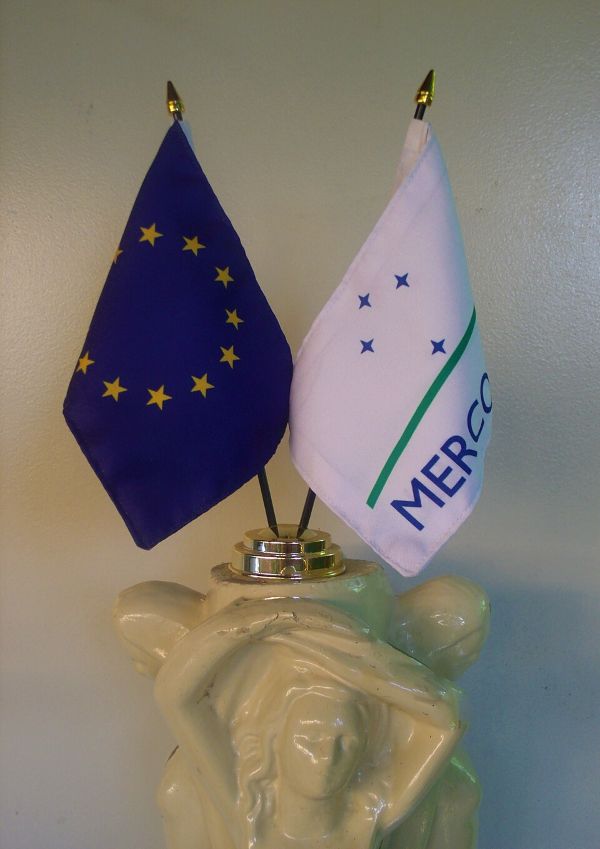
On Wednesday, European Union lawmakers voted to halt the free trade agreement with the Mercosur group of South American countries, citing concerns regarding the deal’s legality. During a session in Strasbourg, France, lawmakers narrowly approved a measure to refer the EU-Mercosur agreement to the European Court of Justice for assessment of its compliance with the bloc’s treaties. The vote resulted in 334 members in favour and 324 against, with 11 abstentions.
This long-awaited agreement, which took 25 years to negotiate, was officially signed on Saturday amid considerable anticipation. The agreement aims to strengthen commercial ties amid rising protectionism and global trade tensions. Supported by the agricultural sectors of South American nations and European industrial interests, it seeks to eliminate over 90% of tariffs on a variety of goods, including Argentine beef and German automobiles, thereby creating one of the world’s largest free trade zones and potentially lowering consumer prices for over 700 million people.
France, as the European Union’s leading agricultural producer, has advocated for enhanced protections for farmers and has sought to delay the implementation of the pact.
The European Commission has expressed regret over the parliament’s decision. The agreement cannot be approved by the assembly until a ruling from the European Court of Justice is obtained, which could take several months. Nonetheless, the EU’s executive branch retains the authority to apply the deal on an interim basis.
EU leaders are expected to convene an emergency summit on Thursday to discuss the path forward for transatlantic relations. In a statement on social media, German Chancellor Friedrich Merz characterised the EU parliament’s decision as “regrettable,” asserting that it misrepresents the geopolitical landscape. He expressed confidence in the agreement’s legality and emphasised the necessity of prompt provisional application.
Ratification of the agreement is viewed as virtually assured in South America, where it enjoys broad support. The Mercosur bloc includes Argentina and Brazil as its two largest economies, along with Paraguay and Uruguay. Although Bolivia, the newest member, is not included in the current trade deal, there are prospects for future participation. Venezuela has been suspended from the bloc and is not part of this agreement.
This article used information from The Associated Press.
