
The local celebration day for the Spanish exclave of Ceuta turned out to have a bigger national impact, a month after the town became the epicentre of a border and migrant crisis.
Traditionally, 2nd September is celebrated in Ceuta, the 84,000-strong Spanish town on the African coast, as the day Portuguese soldiers claimed the territory in 1415 – a claim that later led to its joining Spain in 1580. What is usually a chance to showcase local pride with an official ceremony, music, and cultural events became, this year, the occasion for protests in Ceuta and on the Spanish mainland.
The issue is the aftermath of what happened in late July, when 72,000 illegal immigrants forced their way inside the town from Morocco. The push left 90 people dead. The vast majority were ushered back over the border, with around 5,000, including 1,200 minors, still in Ceuta, according to national authorities. Local authorities mention a higher figure. Those remaining are sleeping in the streets or sheltered on the beach while the government is trying to register and deport them back to Morocco.
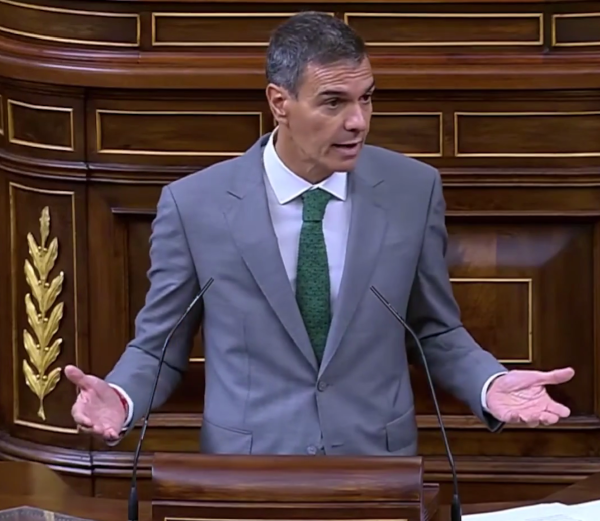
The Spanish government attributed the sudden mass arrivals to a mixture of disinformation about a Supreme Court ruling and a fake-news campaign on social media. The Spanish Prime Minister Pedro Sanchez accused Russia and Israel of being behind those campaigns to destabilise the European Union and Spain. The government has not yet provided examples of Russian and Israeli involvement, other than citing internal reports from the Foreign Affairs Ministry and the European Commission. Both countries refuted the claim.
The protest in Ceuta spilt over on the mainland with around 50,000 in Madrid, and smaller protests were held in more than 200 other municipalities across the country. In Madrid, the protest turned violent, and the Associated Press reported that police shot rubber bullets and tear gas at protesters. The nonpartisan Spanish Federation of Municipalities and Provinces organised the protests. Still, they receive strong support from opposition parties, particularly the leading conservative People’s Party and the far-right, strongly anti-immigration Vox party.
Overall, the protesters shouted their dissatisfaction at the government and its handling of the issue. The government rebuked the protest as purely politically motivated, with Spain’s minister of territorial policy, Angel Víctor Torres, saying on Spanish National Radio that “this is not to show support for the city of Ceuta or its residents; it is to attack the government of Spain.”
In Ceuta, the leader of the region, Juan Jesús Vivas, said that what happened in July “was not a migratory crisis” but “was the violation of Spain’s territorial integrity.” Vivas, who hails from the Popular Party, said that the focus now should be on bringing the city back to normality and urged the government to reinforce the border with Morocco rather than seek cooperation. “If we don’t do this, there will always be someone tempted to use migration as a tool for political ends,” Vivas said.
Sanchez released a video the same day to residents of Ceuta, saying that the government is working with all its resources to bring the situation back to normal. The government pledged €309 million for social services, the economy and the security of Ceuta.
This article used information from The Associated Press.
