
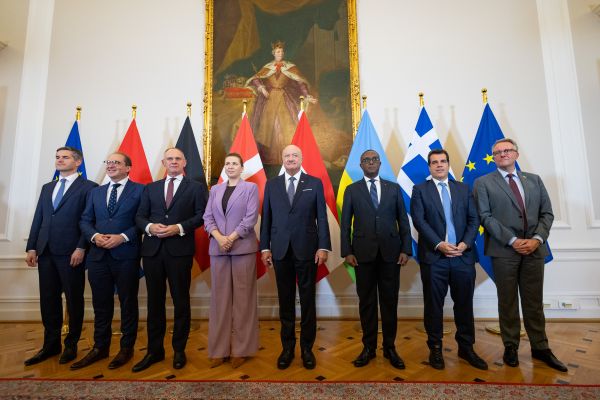
A coalition of European countries announced on Monday its intention to establish a “return hub” in Rwanda, aiming to facilitate the transfer of rejected asylum-seekers starting next year. This initiative is part of a broader effort to discourage more people from seeking asylum in Europe. For several years, the European Union has been focused on tightening migration regulations, reducing the influx of asylum-seekers into the 27-member bloc, and increasing deportations of migrants lacking the right to remain. Establishing processing centres outside Europe has become a central element of this strategy.
The countries spearheading this initiative—Austria, Denmark, Germany, Greece, and the Netherlands—shared their plans during a press conference attended by Rwanda’s interior minister. Austrian Chancellor Christian Stocker highlighted the goal of commencing operations at the Rwanda centre next year. Danish Prime Minister Mette Frederiksen characterised the initiative as a significant opportunity to address the challenges associated with illegal migration, stating, “We aim to dismantle the business model of human smugglers, regain control of our borders, and eliminate the incentives for illegal migration.” She added that many other European countries are likely to support this effort.
Additionally, Denmark’s immigration minister, Morten Bødskov, said a fully negotiated agreement with Rwanda is expected in the coming months. This announcement has elicited prompt criticism from various human rights organisations.
European officials point to a deterrent effect
Officials provided limited information on the number of migrants that may be sent to Rwanda, but emphasised the plan’s intended deterrent effect. Frederiksen stated, “The most significant figure is the one we will never see, as hopefully individuals will not begin their journey to Europe. This marks an important milestone.”
Rwandan Interior Minister Vincent Biruta conveyed that his country aims to offer a “second chance” to individuals who lack the right to reside in Europe. He clarified that those who arrive will have the opportunity to either “voluntarily return to their countries of origin, integrate into Rwandan society, or relocate to another destination where they hold legal residency rights, based on their preferences.”
In response to inquiries about how Rwanda would uphold refugees’ human rights, Biruta assured that the country would engage organisations such as the UN refugee agency and that “an independent monitoring mechanism” would be established to ensure adherence to human rights standards.
Human rights organisations express significant concerns
Human rights organisations have expressed significant concerns regarding the recent plans to deport migrants to facilities in third countries. They argue that European nations may not be able to guarantee human rights protections in these locations. However, European officials maintain that the proposed centres will adhere to both European and international legal standards.
Clementine de Montjoye, a researcher for Human Rights Watch, criticised these initiatives, stating, “Offshore deportation centres represent a concerning attempt by the EU to transfer its responsibilities to other countries. Funding Kigali to host a deportation programme not only risks inflicting suffering on those deported but also grants financial resources and political leverage to a government that has a record of serious human rights violations.”
Additionally, Aimée Stuflesser, an expert on asylum and migration at Amnesty International Austria, remarked, “The recent deportation agreement between European countries and Rwanda echoes past mistakes. Transferring individuals to a country they are unfamiliar with is irresponsible, presenting a genuine risk that the Rwanda deal may, due to its limited opportunity for oversight, evolve into a significant violation of human rights.”
The United Nations High Commissioner for Refugees (UNHCR) has clarified that it supports only the establishment of return hubs aligned with human rights standards and designed to facilitate the return of individuals whose asylum claims have been denied following a comprehensive and fair evaluation.
UNHCR spokesperson Matthew Saltmarsh noted that the agency is engaged in “constructive discussions” with five EU countries to ensure that the return hub process adheres to international human rights law.
Currently, no agreements have been signed with these countries. The International Organisation for Migration (IOM) has stated that it does not participate in or negotiate “state-to-state removal arrangements.” Still, it is offering technical input regarding the return hub process. IOM has also indicated its readiness to assist migrants at the request of the receiving government, provided necessary safeguards are in place.
In recent years, EU legislation has been modified in response to ongoing public and political pressure for stricter migration measures. In June, European lawmakers voted to allow member states to set up centres outside the EU, either independently or in small coalitions so that they can send rejected asylum seekers to these facilities instead of returning them to their home countries.
Europeans say plan isn’t comparable to scrapped UK deal
In 2022, the UK struck a deal with Rwanda to send migrants arriving as stowaways or by boat to have their asylum claims processed there. However, the UK Supreme Court ruled this policy unlawful, stating that Rwanda is not a safe third country. After taking office in 2024, Prime Minister Keir Starmer immediately scrapped the deal.
German Interior Minister Alexander Dobrindt said the European plan for Rwanda is different, as it applies to individuals who have already exhausted their asylum appeals, rather than outsourcing processing to third countries as the UK intended.
This article used information from The Associated Press.
