
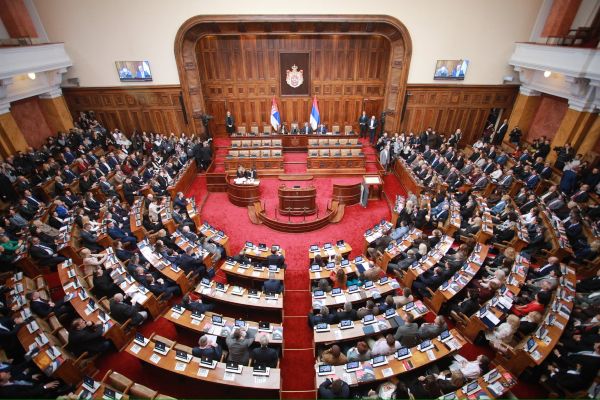
Serbia’s new parliament convened on Tuesday for its inaugural session after a remarkable election victory last month by a grassroots, student-led movement that ousted authoritarian former President Aleksandar Vučić and his political party. This session of the National Assembly represents a significant milestone in establishing a new government in Serbia. Notably, it marks the first time in the Balkans that a newly formed protest movement has achieved a parliamentary majority.
During this session, lawmakers are expected to elect a parliamentary speaker, as well as deputies and various parliamentary committees. A vote on these appointments is scheduled for Wednesday, following a session dedicated to procedural matters and a debate. A new government must be formed within 90 days.
The Students’ List (SL) movement currently holds 140 of the 250 seats in parliament, compared with the 103 seats held by Vučić’s nationalist Serbian Progressive Party (SNS). After his tenure as defence minister, prime minister, and president over the past 14 years, Vučić now serves as an opposition lawmaker. The remaining parliamentary seats are occupied by parties representing Serbia’s ethnic minorities.
Vučić shifts first session of the assembly into a circus
In Belgrade, Aleksandar Vučić spoke at the first session of the new parliament, blaming the Student List for various incidents following the 25 October elections, including a yoghurt attack on one of his deputies.
A crowd gathered in front of the building to greet the SL deputies while booing Vučić and his SNS. During his lengthy speech, Vučić assured lawmakers that his party would not obstruct parliamentary proceedings but hinted at upcoming protests without providing details. He accused students of “revolutionary terror,” following a wave of post-election arrests involving officials and a bank owner.
In a tense assembly atmosphere, Vučić spoke for over an hour, expressing concern for Serbia’s regression and highlighting a drop in unemployment during his 14 years in power. He rejected claims of document destruction and asked SL members to apologise for the yoghurt incident.
He condemned dismissals and arrests of various officials, referring to the Student List as a regime. Vučić asserted his right to speak as long as necessary before concluding.
Preparing for a democratic function of parliament
The upcoming debate on Tuesday and Wednesday will focus on electing the new president of the assembly. With support from the Students’ List, the likely candidate is Aleksandar Čupić, a professor known for his height and long white beard, who sang a song about Serbia at protests.
Serbian media report that newly elected lawmakers have been preparing for the session, where they will confront experienced opposition members known for aggressive attacks. The SNS caretaker government will remain until a new Cabinet is formed.
Serbia must also hold an early presidential election by the end of the year, triggered by Vučić’s resignation in September during his failed bid to become prime minister.
Protests began in November 2024 after a concrete canopy collapsed at a train station, killing 16 people. Many blamed this on poor renovation and corruption. The Students’ List aims to restore democracy and fight corruption and cronyism that flourished under Vučić.
However, they may face significant challenges in parliament. They have vowed to keep the session from turning into a “reality show.” The live broadcast on state-run RTS drew a large audience, and some bars in Belgrade offered special deals for viewers.
Meetings in Brussels
A recent enlargement forum in Brussels featured Aleksandar Baucal, a psychology professor and representative of the SL. He said Serbia will be a reliable partner to the EU and its neighbours, emphasising the importance of reforms and democratic values. Baucal also met with EU Enlargement Commissioner Marta Kos.
While Serbia is a candidate for EU membership, progress has stalled under Vučić’s rule because of democratic backsliding and close ties with Russia. EU officials have offered support to the future Serbian government for necessary reforms.
This article used information from The Associated Press.
