
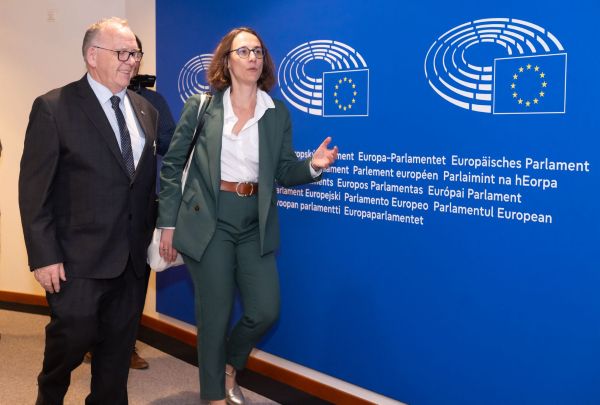
During the September plenary session, the European Economic and Social Committee (EESC) and the French Economic, Social and Environmental Council reaffirmed their commitment to participatory democracy and to shaping a better future for Europeans. Claire Thoury, the new President of the French Council, chose to visit the EESC first.
In the debate, she highlighted key issues facing the EU, including attacks on European values, poverty, unemployment, artificial intelligence, and climate change. Thoury stressed that “addressing today’s challenges requires a united Europe” and emphasised the need to restore trust in democratic institutions amid rising disinformation and polarisation.
“We are facing aggressive attacks on our values to which we must respond more decisively,” said the EESC President Séamus Boland. “No consultative body, in Europe or elsewhere, can take its legitimacy for granted. Recurrent attacks on such institutions remind us that we must remain united, continue to demonstrate our added value, earn trust, and speak clearly and forcefully about the importance of consultative assemblies.”
President Thoury highlighted the vital role of organised civil society, saying it promotes fairness by testing political decisions in real life. She urged strengthening societal bonds and emphasised that defending organised civil society is essential to democracy.
The discussion highlighted growing collaboration between the EESC and the French Economic, Social and Environmental Council, focusing on people-centred work programmes. Their partnership includes thematic discussions and joint events, reflecting a commitment to innovation.
“I believe in civil society diplomacy,” noted Thoury. The recent “Erasmus of organised civil society” exchange programme allows members from both councils to build closer ties and share policy insights.
In addition, the French Council will soon launch the Citizens’ Convention on public finances. In today’s challenging geopolitical landscape, this collaboration is crucial. The EESC has established a network of 24 national economic and social councils to facilitate the exchange of expertise.
“If Europe is to remain competitive while becoming more social, representative and inclusive,” concluded Boland, “our assemblies must continue to serve as vital platforms for dialogue between citizens, the executive and legislative authorities at both national and EU level.”
During the September plenary session, civil society representatives called for stronger cooperation.
“Strategic cooperation between our Committee and national economic and social councils is essential for enhancing our adaptability and impact. Together, we are beacons of democracy. A strong economic and social council ensures civil society has a voice, which strengthens democracy,” stated Cillian Lohan, President of the EESC’s Civil Society Organisations’ Group.
“The French Council is significant in our history; its model of dialogue inspired the EESC. This experience can benefit countries beyond the EU. Let’s share our insights to help each interested nation develop a suitable model,” emphasised Dumitru Fornea, EESC member from the Workers’ Group.
“A vibrant democracy relies on a strong civil society that is heard. Our organisations — the French Council and the EESC — play this role at different levels. Better coordination between national and European levels will amplify the voice of civil society in Europe,” added Michel Chassang, EESC member from the Employers’ Group.
